Industry Insights & Beauty Trends
Expert strategies, cosmetic manufacturing guides, and growth tips for beauty brand founders.
China Top 10 Private Label Brow Manufacturers Guide
Table of Contents
Choosing a reliable Private Label Brow Manufacturer requires more than comparing product prices. Brow pencils, gels, pomades, and powders must perform consistently from the first application to the final wear test. This guide introduces ten China-based manufacturers connected with private label brow production. It focuses on practical factors that affect real purchasing decisions.
The evaluation considers formula development, shade accuracy, packaging options, minimum order quantities, and production flexibility. It also examines sample quality, factory communication, quality control, and documented compliance practices. A good manufacturer should explain ingredient specifications clearly. They should provide stable samples, realistic lead times, and traceable production information. Small details matter, such as a smooth pencil tip, a secure cap, and clean label printing.
Not every supplier will suit every brand. Some may offer stronger color development, while others may support lower starting volumes. Rankings can also change as capabilities, equipment, and service teams develop. That is worth remembering. Buyers should verify current certifications, test samples independently, and confirm written specifications before placing an order. Product claims should remain accurate and supportable in the intended market.
This guide is designed for founders, retailers, and established beauty companies seeking informed sourcing options. It combines visible product details with questions that deserve deeper investigation. Factory photographs can look impressive. They are not proof of consistent quality. Real confidence comes from repeat samples, clear records, and dependable communication. The goal is not to select the cheapest factory, but to identify a capable partner for safe, consistent, and commercially suitable brow products.
What Private Label Brow Manufacturing Involves
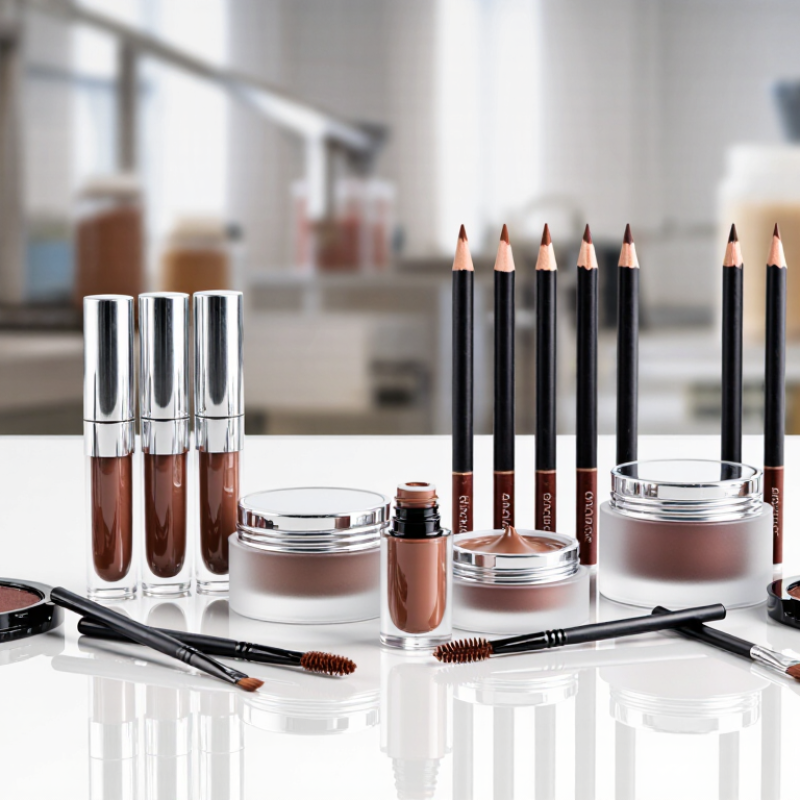
Private label brow manufacturing turns a product concept into a controlled, sellable formula. The process usually begins with the brow format: pencil, powder, gel, pomade, or hybrid. Each format requires different waxes, pigments, preservatives, and filling equipment. A technical team then adjusts texture, payoff, adhesion, and removal. Small differences matter.
Shade development needs more than a digital color chart. A reliable manufacturer prepares physical samples and checks them under different lighting. The team may test undertones, oxidation, transfer resistance, and wear across skin types. Packaging compatibility is also practical. A gel can clog a fine brush, while a pencil may break during filling. Details decide quality.
Quality work includes batch records, ingredient traceability, stability checks, microbiological testing where applicable, and documented release inspections. Manufacturers should explain sampling plans, tolerances, lead times, minimum order quantities, and corrective actions before production. Independent review of labels and claims can reduce compliance problems in each target market. Still, no first sample is perfect. Test it twice. I would question any supplier promising identical results without discussing raw-material variation, equipment limits, and realistic production controls.
How to Evaluate China’s Top Brow Product Manufacturers
China Top 10 Private Label Brow Manufacturers Guide
Evaluating China’s leading private label brow manufacturers requires more than comparing catalog photos. Begin with product fit. Request samples of pencils, gels, powders, or pomades that match your target market. Check color payoff, application drag, drying time, transfer resistance, and removal. Test them on different skin types when possible. A good sample is not enough. Repeat the test after several weeks.
Ask for valid business registration, cosmetic production qualifications, ingredient lists, safety documents, and batch records. Requirements differ across markets, so confirm details with a qualified regulatory specialist. During a factory audit, inspect incoming material checks, weighing controls, filling accuracy, sealing, and storage conditions. Ask whether testing is performed internally or by an independent laboratory. Details matter.
Use a scorecard covering quality, communication, minimum order quantity, tooling fees, lead time, and change control. Require written product specifications and an approved reference sample before mass production. Check whether packaging protects the formula from drying, leakage, or breakage. A polished factory tour can still mislead. I would also review a pilot batch, because production results may differ from laboratory samples. Slow replies, unclear test reports, or unexplained formula changes deserve careful questioning.
The Top 10 Private Label Brow Manufacturers in China
China Top 10 Private Label Brow Manufacturers Guide
The Top 10 Private Label Brow Manufacturers in China
China’s private label brow sector serves pencils, powders, gels, and laminated-look formulas. Grand View Research estimates that the global eye makeup market will keep expanding through 2030, supported by online beauty sales and shade diversity. Brow products benefit from this shift because they are affordable, compact, and easy to demonstrate through short videos. Still, market growth does not prove factory quality.
A practical review of the top 10 private label brow manufacturers in China should examine formula records, color consistency, and production controls. Request ISO 22716 or equivalent cosmetic manufacturing evidence. Ask for batch samples, stability results, ingredient specifications, and packaging compatibility tests. A reliable factory should explain how it controls wax hardness, pigment dispersion, brush release, and waterproof claims. Test the pencil on oily skin, not only on paper. Small details matter.
The Business Research Company identifies personalization and direct-to-consumer distribution as important cosmetics trends. Chinese suppliers often support low-to-medium minimum orders, custom shade development, and flexible packaging. However, some catalogs look stronger than their actual laboratory capacity. That is a warning sign. Compare sample performance across three production batches. Check whether the same brown shade changes under warm lighting. Review lead times, inspection procedures, and corrective-action records before signing. I would also question unusually low quotations; cost savings can hide weaker pigments, fragile caps, or rushed filling. Supplier audits should remain practical, documented, and repeated when volumes increase.
Comparing Products, Customization, Quality, and Pricing
China Top 10 Private Label Brow Manufacturers Guide
Private label brow products now require more than attractive packaging. McKinsey’s 2023 beauty report expects the global beauty market to approach $580 billion by 2027. Brow pencils, gels, powders, and laminating-style products must therefore compete on performance and consistency. When comparing China’s top manufacturers, request samples across several shades. Check pigment payoff, spoolie strength, drying time, and wear after eight hours. Small defects matter.
Customization can include formula texture, shade development, component molds, cartons, and safety documentation. However, deeper customization usually increases minimum order quantities and development fees. A standard formula may reduce launch costs. It may also limit differentiation. Grand View Research reports continued growth in color cosmetics, but market growth does not excuse weak quality control. Ask for batch records, stability testing, microbiological testing, and ISO 22716-based manufacturing procedures.
Pricing should be compared by landed cost, not unit quotation alone. Include sampling, tooling, packaging, inspection, freight, and potential rework. In practical evaluations, the cheapest supplier is rarely the cheapest outcome. I once focused too heavily on a low sample price; the formula looked good, but the carton tolerance was disappointing. That mistake remains useful. Require written specifications, retain approved samples, and confirm how shade changes are handled between batches.
China Top 10 Private Label Brow Manufacturers Guide - Comparing Products, Customization, Quality, and Pricing
| Rank | Supplier Profile | Main Brow Product Coverage | Typical MOQ | Private Label Customization | Packaging Options | Sample Lead Time | Bulk Production Lead Time | Typical FOB Price Range | Quality & Compliance Support | Best Fit |
|---|---|---|---|---|---|---|---|---|---|---|
| 1 | Profile 01 | Brow Pencil Brow Gel Brow Powder | 1,000–3,000 units per shade | Formula adjustment, shade matching, logo printing, artwork support | Stock tubes, custom cartons, stickers, foil stamping | 7–12 working days | 30–45 working days | US$0.55–1.35/unit | Batch testing, stability guidance, ingredient documentation, ISO 22716 support commonly available | Retailers seeking a balanced product range and moderate MOQ |
| 2 | Profile 02 | Micro Brow Pencil Brow Marker Brow Soap | 3,000–5,000 units per SKU | High-precision tip options, color development, customized applicators | Dual-ended packaging, molded inserts, printed boxes | 10–15 working days | 35–50 working days | US$0.70–1.80/unit | Color consistency checks, packaging compatibility testing, MSDS and COA support | Brands focused on precision application and dual-ended formats |
| 3 | Profile 03 | Brow Gel Laminating Gel Tinted Mascara | 2,000–5,000 units per SKU | Clear or tinted formulas, hold-level adjustment, brush selection | Standard tubes, custom wands, PCR packaging options | 8–14 working days | 30–45 working days | US$0.65–1.60/unit | Preservative review, microbial testing, stability testing, EU/US document preparation | Clean-beauty and brow-lamination product lines |
| 4 | Profile 04 | Brow Powder Brow Palette Wax Pomade | 1,000–2,000 units per shade or palette | Pressed-powder shades, pan layout, texture selection, palette design | Magnetic palettes, mirrors, custom pans, paper cartons | 10–18 working days | 35–55 working days | US$0.85–2.40/unit | Shade drawdown approval, pressing checks, drop testing, packaging inspection | Multi-shade collections and makeup retailers |
| 5 | Profile 05 | Brow Pencil Mechanical Pencil Highlighter | 5,000–10,000 units per SKU | Private mold development, pencil hardness, refill and component selection | Wooden or automatic pencils, custom caps, printed cartons | 12–20 working days | 40–60 working days | US$0.45–1.25/unit | Mechanical function testing, lead breakage checks, artwork and barcode review | High-volume programs requiring competitive unit pricing |
| 6 | Profile 06 | Brow Soap Clear Wax Brow Styling Kit | 1,000–3,000 kits or units | Fragrance-free options, hold strength, kit component selection | Jars, tins, boxes, brushes, mini spoolies, gift sets | 7–14 working days | 25–40 working days | US$0.75–2.10/unit | Microbial testing, product safety documents, component inspection | Starter brands, gift sets, and social-commerce launches |
| 7 | Profile 07 | Brow Serum Conditioning Gel Nourishing Oil | 3,000–5,000 units per formula | Active ingredient selection, texture modification, dropper or brush design | Glass bottles, mascara-style tubes, cartons, recyclable components | 15–25 working days | 40–60 working days | US$1.10–3.20/unit | Stability and compatibility testing, ingredient traceability, claims review support | Skincare-led brands and treatment-positioned brow products |
| 8 | Profile 08 | Brow Pencil Brow Gel Brow Powder Brow Kit | 500–1,500 units per SKU for stock formulas | Fast-label service, limited shade customization, ready-made SKU combinations | Stock packaging, label application, simple printed cartons | 5–10 working days | 20–35 working days | US$0.60–1.90/unit | Basic COA and MSDS availability, incoming and finished-goods inspection | Small businesses testing demand with lower initial investment |
| 9 | Profile 09 | Waterproof Pencil Long-Wear Gel Tinted Wax | 3,000–8,000 units per SKU | Wear-time targets, waterproof performance, applicator and color customization | Aluminum components, premium cartons, soft-touch or metallic finishes | 12–18 working days | 35–50 working days | US$0.90–2.60/unit | Water-resistance testing, wear evaluation, packaging and batch inspection | Professional makeup and long-wear positioning |
| 10 | Profile 10 | Brow Pencil Brow Gel Brow Powder Accessories | 1,000–3,000 units per SKU | End-to-end ODM support, formula selection, shade library, packaging engineering | Custom components, sustainable paper packaging, brushes and tweezers | 10–16 working days | 30–50 working days | US$0.80–2.80/unit | Pre-production samples, AQL inspection options, COA, MSDS and regulatory file support | International brands needing coordinated product and packaging development |
How to Select the Right Manufacturer for Your Brand
Choosing a private label brow manufacturer requires more than comparing catalog photos. According to McKinsey’s 2023 beauty market analysis, global beauty revenue could reach about $580 billion by 2027. That growth increases competition. Your supplier must help create a dependable product, not only a low quotation.
Ask for formulation samples, ingredient specifications, and recent batch records. Check whether the facility follows recognized cosmetic GMP guidance, such as ISO 22716. Request stability, microbiological, heavy-metal, and packaging-compatibility testing where appropriate. Records matter. A brow pencil should apply evenly, resist crumbling, and remain stable in a warm warehouse. Test the texture yourself. Brow gel also needs controlled drying time, clean removal, and a brush that does not overload the applicator.
Review minimum order quantities, sample fees, production capacity, lead times, and defect procedures. Grand View Research has identified private-label cosmetics as a growing market, but rapid growth can hide weak quality controls. Ask how the manufacturer handles shade adjustments and formula changes. Require written specifications before production begins. Verify labeling support for your target markets, while obtaining independent legal review. Communication is another practical test. Send three detailed questions and observe the response. Slow replies may become expensive later. I would not choose a factory solely because it offers the lowest MOQ; that decision can create inconsistent batches and excess packaging. Audit reports help, but an on-site visit or qualified third-party inspection gives stronger evidence. Ask why.
China Top 10 Private Label Brow Manufacturers Guide
How to Select the Right Manufacturer for Your Brand
This 100-point procurement scorecard prioritizes the factors commonly used when evaluating private label brow manufacturers. Quality and safety receive the highest weighting, followed by regulatory readiness, production flexibility, lead time, customization, and packaging sustainability. Use the framework to compare shortlisted suppliers without relying on brand or company rankings.
FAQS
Start with product samples, not catalog photos. Test pencils, gels, powders, or pomades on different skin types. Check color payoff, application drag, drying time, transfer resistance, and removal. One good sample proves little.
Request valid business registration, cosmetic production qualifications, ingredient lists, safety documents, and batch records. Ask for ISO 22716 or equivalent manufacturing evidence. Confirm market-specific requirements with a qualified regulatory specialist. Documents should be current.
Oily skin can expose weak adhesion and poor wear performance. Test the pencil on skin, not only on paper. Observe smudging, fading, and transfer after several hours. Paper is too forgiving.
Review incoming material checks, weighing controls, filling accuracy, sealing, and storage conditions. Ask whether testing occurs internally or through an independent laboratory. Inspect caps, brushes, and containers for damage. A polished tour may still mislead.
Use a scorecard covering quality, communication, minimum order quantity, tooling fees, lead time, and change control. Record every result. Compare samples from at least three production batches. My first impression might be wrong.
Request written product specifications and an approved reference sample. Review stability results, ingredient specifications, packaging compatibility tests, and batch samples. Ask for corrective-action records. Laboratory samples may differ from factory output.
Test the same brown shade under warm, cool, and natural lighting. Compare color payoff across multiple batches. Check pigment dispersion and formula texture. Small changes become obvious on the brow.
Slow replies, unclear test reports, unexplained formula changes, and unusually low quotations deserve attention. Low costs may indicate weaker pigments, fragile caps, or rushed filling. Ask direct questions. Do not assume.
Conclusion
This guide explains what private label brow manufacturing involves, from product formulation and shade development to packaging, labeling, sampling, and production support. It also outlines how to evaluate China’s top brow product manufacturers by reviewing their experience, quality systems, ingredient transparency, production capacity, certifications, communication, and ability to meet international market requirements. The goal is to help emerging and established beauty businesses understand the full process before placing an order with a Private Label Brow Manufacturer.
The guide presents ten leading types of manufacturing partners in China and compares their product ranges, customization options, quality control procedures, minimum order quantities, lead times, and pricing structures. It also offers practical advice for selecting the right supplier based on your brand concept, target customers, budget, desired level of customization, and long-term growth plans. By comparing these factors carefully, buyers can choose a reliable partner capable of delivering consistent brow products and professional support.

Blog Tags: