Industry Insights & Beauty Trends
Expert strategies, cosmetic manufacturing guides, and growth tips for beauty brand founders.
How to Choose the Best Skinny Brow Pencil Supplier?
Table of Contents
- Understanding Skinny Brow Pencil Types and Product Requirements
- Assessing a Supplier’s Manufacturing Capabilities
- Verifying Quality Standards and Regulatory Compliance
- Comparing Pricing, Minimum Orders, and Delivery Terms
- Evaluating Communication and Long-Term Partnership Potential
- FAQS
- Conclusion
- Related Posts
Choosing the right supplier for a Skinny Brow Pencil takes more than comparing prices or browsing attractive product photos. Brands need a partner who can deliver consistent quality, clear communication, and dependable production timelines. The pencil should apply smoothly, create fine-looking strokes, and resist breaking during ordinary use. Small details matter: the sharpness of the tip, the feel of the casing, and whether the cap stays secure in a makeup bag. Looks promising? A sample can reveal what a catalog cannot.
A careful evaluation starts with specific questions. Ask about formula options, shade range, minimum order quantities, customization, and quality checks. Request samples from the same product range you plan to order, then assess application, pigment consistency, and packaging in realistic conditions. Review available product specifications and supporting documents, and confirm how the supplier handles defects or delays. Compare answers in writing, not just during a sales call. Price matters, but the lowest quote may leave out packaging, testing, or other practical costs. I would not treat a polished presentation as proof of reliable manufacturing; that assumption is easy to make, and sometimes wrong. A strong supplier should explain limitations as clearly as capabilities. This guide explores the questions, sample checks, and sourcing signals that help brands make a more informed choice without overlooking the details that show up after launch.
Understanding Skinny Brow Pencil Types and Product Requirements
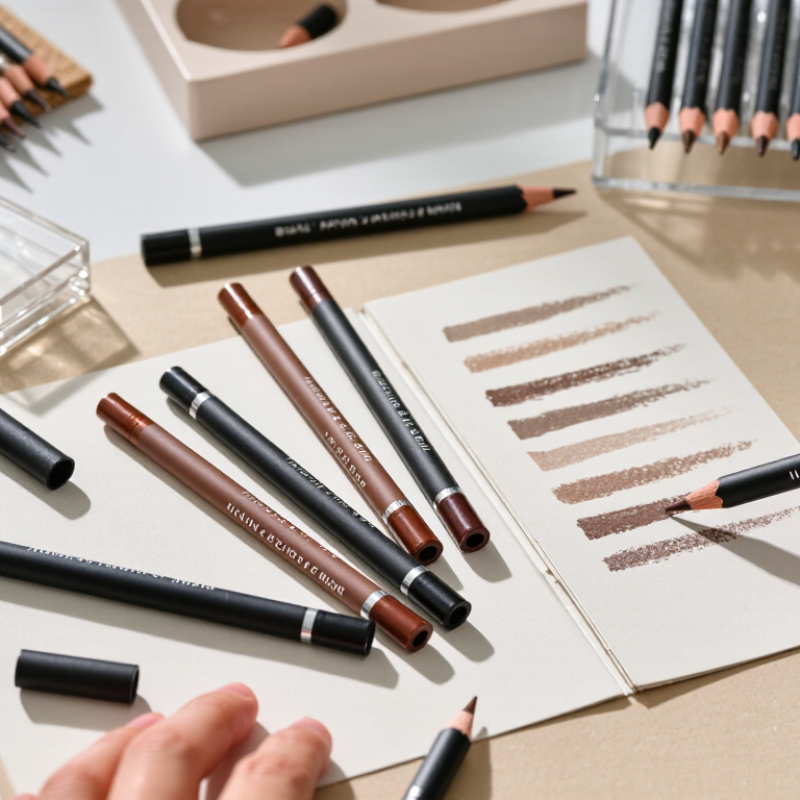
Skinny brow pencils are not all the same. Most use a fine twist-up core, while some are sharpenable or paired with a spoolie. A 1.5–2 mm tip can draw hair-like strokes, but the exact diameter matters less than how evenly it applies. Too soft, and the core may smear or break. Too hard, and color can skip across dry skin.
Define product requirements before comparing suppliers. Check shade range, core firmness, payoff, wear time, and whether the pencil needs a built-in sharpener or spoolie. Test samples on different skin tones and over a full workday. Look closely in bright light. Does the pigment look natural, or too warm? Does the cap stay secure in a packed bag? Small details become customer complaints.
Ask suppliers how they control core dimensions, color consistency, and assembly from batch to batch. Request samples from more than one production run if possible, then compare them side by side. I would also check packaging fit and spoolie stiffness; these are easy to overlook. A polished sample is useful, but it cannot tell the whole story. Some requirements may need adjusting after real wear tests, and that is normal.
Assessing a Supplier’s Manufacturing Capabilities
A skinny brow pencil depends on a narrow balance: smooth color payoff, a firm core, and a tip that resists snapping. McKinsey’s 2023 beauty-market report valued the global industry at about $430 billion and projected it could reach $580 billion by 2027. Scale raises the stakes. A supplier should explain how it keeps pencil performance consistent across production runs, not just make an attractive sample.
Ask how the factory controls core diameter, pigment dispersion, hardness, and fill weight. Request test records for breakage, twist-up function, and color consistency across batches. Then compare samples from different production runs. Look closely at the tip after repeated use; a pencil that crumbles on a test card may disappoint in daily application. Ask to see it. A clear explanation of equipment, inspection frequency, and corrective actions is stronger evidence than a polished facility tour.
Also check whether the supplier can document material lots and trace finished goods back to production records. Ask about its normal output, lead times, and how it handles a rejected batch. Small pilot runs can reveal issues before a larger order, though they may not predict every production problem. I would not treat one successful sample as proof. Manufacturing details are easy to overlook when packaging looks perfect, and I might still miss a flaw without testing several batches.
Verifying Quality Standards and Regulatory Compliance
A skinny brow pencil needs more than a precise tip; its formula, casing, and cap must perform consistently across batches. Ask suppliers for current GMP documentation, such as alignment with ISO 22716, plus batch-specific certificates of analysis. Check that ingredient specifications, colorant records, stability results, and packaging compatibility tests are traceable. Cosmetics Europe’s 2024 Market Performance report estimated European cosmetics retail sales at €96 billion in 2023. That figure signals a large, closely scrutinized market, not proof that any supplier meets your requirements. Paperwork is not proof. Review actual records and confirm which markets the product will enter, since cosmetic rules differ by region.
Tips: Request a sample from a routine production batch, not only a polished showroom sample. Compare shade, glide, breakage, and cap fit. Ask how the supplier investigates out-of-spec results and tracks corrective actions. For US sales, verify the supplier’s readiness for applicable MoCRA requirements; for EU sales, confirm that the responsible-party and product-safety documentation process is clear. A supplier may pass one audit and still have weak batch records. That deserves a closer look. Keep a written checklist, record test dates, and revisit documents when ingredients or manufacturing sites change.
Comparing Pricing, Minimum Orders, and Delivery Terms
How to Choose the Best Skinny Brow Pencil Supplier?
Comparing Pricing, Minimum Orders, and Delivery Terms
A low unit price can hide expensive setup fees, packaging charges, or costly shipping. Compare the full landed cost for the same pencil specification: tip size, formula, shade range, packaging, and inspection requirements. Cosmetics Europe reported European cosmetics and personal care retail sales of €96 billion in 2023, showing the scale of the market—but strong demand does not guarantee that a supplier can meet your schedule. Ask for a written quote with price breaks at several order quantities. Then check whether the quoted price includes samples, artwork changes, and quality checks. Small details matter.
Minimum order quantities can tie up cash in slow-moving shades. Request a trial order, or ask whether the supplier can split a larger production run across approved shades. Confirm what happens if a shade fails inspection. Delivery terms need equal attention: clarify production lead time, shipping method, who pays freight, and when responsibility transfers. Get dates in writing, not just “about six weeks.” A supplier may answer quickly and still miss a deadline; that is worth weighing.
Tips: Compare three like-for-like quotes. Ask for recent on-time delivery figures and a sample approval timeline. Check whether the delivery estimate includes customs clearance. Keep a small buffer for delays. It may feel overly cautious, but a late launch can cost more than a slightly higher pencil price.
How to Choose the Best Skinny Brow Pencil Supplier?
Compare indicative unit pricing and minimum order quantities across three generic sourcing scenarios. Lower unit prices often come with larger order commitments.
Delivery terms: For planning purposes, allow roughly 25–35 days for a flexible-MOQ order, 30–45 days for a mid-volume order, and 35–55 days for a high-volume order. Confirm production time, shipping method, payment terms, and whether samples are included before comparing quotes.
Illustrative estimates only, not verified supplier quotes. Actual prices, MOQs, and lead times vary with formula, packaging, customization, order quantity, and destination. Request quotes using the same product specifications.
Evaluating Communication and Long-Term Partnership Potential
A skinny brow pencil supplier’s communication is easiest to judge before a purchase order, when questions are still easy to answer. Ask about tip diameter, breakage testing, shade matching, cap fit, and how samples are revised. Look for specific answers, not reassuring phrases. A useful contact explains what can be confirmed, what needs testing, and when a reply will arrive. Small details matter.
During sampling, send one clear change request, such as a softer glide or tighter cap closure, and note the response time. Does the supplier confirm the revised specification in writing? Do they flag cost or lead-time effects before changing materials? These exchanges reveal working habits better than a polished sales call. No process is perfect. A delayed answer may be understandable; repeated vague answers about defects or delivery dates are harder to accept.
Long-term potential depends on predictable records and honest escalation. Discuss forecast updates, minimum order quantities, quality checks, and who owns corrective actions if a batch misses agreed tolerances. Request sample and inspection records, then compare them with delivered units. One uncomfortable point: buyers sometimes judge a supplier only by price, then expect instant flexibility. That expectation can strain even a capable team. A stronger partner questions unrealistic timelines, documents decisions, and gives early warning when capacity shifts. This may feel less convenient. More dependable, usually.
FAQS
Compare the full landed cost for the same pencil specifications, including tip size, formula, shades, packaging, and inspection. A low unit price can hide setup or shipping fees. Small charges add up.
Ask for prices at several order quantities. Confirm whether samples, artwork changes, and quality checks are included. Get each item in writing.
Ask about a trial order or splitting a larger run across approved shades. Slow-moving colors can tie up cash. Not ideal.
Request written production dates, shipping methods, freight responsibility, and the point when delivery responsibility transfers. Check whether the estimate includes customs clearance. “About six weeks” is not a firm date.
Ask about tip diameter, breakage testing, shade matching, cap fit, and sample revisions. Request inspection records, then compare them with delivered pencils.
Send one clear change request, such as softer glide or a tighter cap. See whether the supplier confirms revisions and related costs or delays in writing. Specific answers matter.
Ask for recent on-time delivery figures and a sample approval timeline. Keep a small buffer for delays. A quick reply alone proves little.
Discuss forecast updates, order minimums, quality checks, and corrective actions for batches outside agreed tolerances. A dependable supplier flags capacity changes early. Buyers should also question unrealistic timelines; flexibility has limits.
Conclusion
Choosing the right Skinny Brow Pencil supplier starts with understanding the product you need, including its tip shape, formula, color range, packaging, and intended use. Compare potential suppliers’ manufacturing capabilities, customization options, production capacity, and ability to maintain consistent product quality. Ask how they inspect materials and finished goods, and confirm that their quality systems and documentation meet the requirements of your target markets.
Before making a decision, review pricing alongside minimum order quantities, sample costs, lead times, shipping arrangements, and payment terms. A low unit price may not offer the best overall value if communication is slow or delivery schedules are unreliable. Choose a supplier that answers questions clearly, responds constructively to feedback, and can support your plans as order volumes or product needs change. A careful comparison can help establish a dependable partnership and ensure the final product matches your expectations.

Blog Tags: