Industry Insights & Beauty Trends
Expert strategies, cosmetic manufacturing guides, and growth tips for beauty brand founders.
Choosing a Cream Powder Bronzer Duo manufacturer takes more than comparing glossy product photos. Buyers need to examine texture, color payoff, packaging, production capabilities, and quality controls. A cream-to-powder formula should blend without dragging, then settle into a finish that feels comfortable on skin. The compact matters, too. A loose hinge or a pan that lifts during use can undermine an otherwise promising sample.
Cosmetic chemist and science educator Perry Romanowski is a useful reference for a practical formulation perspective. In paraphrase, his broader formulation guidance points to a simple idea: performance, stability, and user experience should be assessed together. This is not a direct quotation. It is a reminder to test more than the first swipe. Compare samples in natural light, check how the cream behaves over foundation, and note whether the powder finish emphasizes dry patches. Small details matter.
This guide introduces ten manufacturers associated with China’s color-cosmetics supply chain. It considers product development, customization, manufacturing experience, and communication, while recognizing that capabilities can vary by facility and order. A supplier’s polished catalogue is not proof of consistent production. Ask clear questions, request representative samples, and verify claims before making a decision. Some comparisons will remain imperfect; public information rarely reveals every production detail. That uncertainty deserves attention, not guesswork.
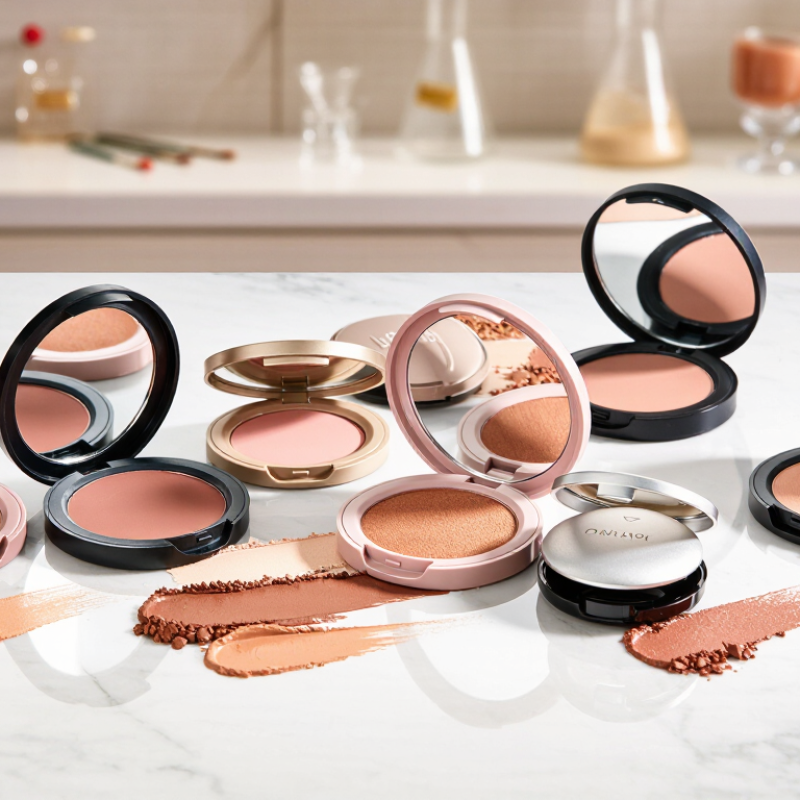
Cream-Powder Bronzer Duos: Product Formats, Formulas, and Uses
Cream-powder bronzer duos combine two textures in one compact: a creamy shade for sheer warmth and a powder shade for soft definition. The cream may use emollients and waxes to glide over the skin, while the powder often relies on finely milled pigments and binders for a more diffused finish. Exact feel depends on the formula, not just its format. A finger can warm the cream on the back of the hand before application. A small brush gives more controlled placement.
These duos suit quick, layered routines. Press cream along the temples and cheekbones, then lightly sweep powder over areas that tend to become shiny. On dry skin, too much powder can emphasize texture; on oilier skin, a thin cream layer may wear differently through the day. Patch testing is sensible, especially for reactive skin. Small details matter: a divider should keep the textures separate, and the compact should close securely to reduce drying or powder fallout. Still, two textures do not guarantee better results. A poorly matched shade or stiff cream can make blending frustrating. That part deserves more attention.
| No. | Duo Format | Cream Component | Powder Component | Typical Finish | Common Use | Application Notes |
|---|---|---|---|---|---|---|
| 1 | Single compact with side-by-side pans | Emollient cream or balm bronzer in one pan | Pressed bronzing powder in a separate pan | Usually buildable; finish depends on the individual formula | Everyday warmth and optional powder layering | Apply the cream with fingers, a sponge, or a brush; use a separate clean brush for the powder. |
| 2 | Single compact with stacked pans | Cream pan positioned above or below the powder pan | Pressed powder pan in the same compact | Soft, layered bronzing effect | Portable touch-ups and travel use | Check the pan layout before use to avoid picking up cream residue with a powder brush. |
| 3 | Refillable compact duo | Replaceable cream pan, commonly made with an emollient base | Replaceable pressed-powder pan | Varies by finish and shade selection | Repeated use with replaceable product pans | Refill systems depend on the compact design; pans should be compatible with the intended case. |
| 4 | Palette duo with a larger cream pan | Broad cream pan designed for use with fingers or a face brush | Smaller pressed-powder pan for targeted layering | Flexible from natural to more defined | Cheek, temple, and forehead bronzing | Use a small amount of cream first and build gradually to help prevent an uneven application. |
| 5 | Palette duo with equal-size pans | Cream bronzer pan sized for similar access to both textures | Powder bronzer pan of comparable size | Designed for either texture or for layering | Choosing cream or powder based on preference and routine | Apply each texture with a suitable tool; blend cream before setting or layering with powder. |
| 6 | Matte cream-and-powder duo | Cream formula with a low-shine or matte appearance | Matte pressed bronzing powder | Matte or soft-matte | Subtle warmth or softly defined facial areas | Use light layers and blend the edges; matte finishes can make visible streaks more noticeable. |
| 7 | Satin cream-and-powder duo | Cream formula with a gentle sheen, depending on its pigments and emollients | Satin-finish pressed bronzer | Soft sheen without necessarily appearing glittery | Adding warmth with a less flat-looking finish | Apply sparingly where a sheen is desired and check the finish in natural light. |
| 8 | Sheer cream-and-powder duo | Sheer or balm-like cream intended for gradual color | Lightly pigmented pressed powder | Natural-looking and buildable | Subtle bronzing and low-intensity makeup looks | Start with a small amount; add thin layers rather than applying a heavy layer at once. |
| 9 | High-pigment cream-and-powder duo | More concentrated cream color that may require careful blending | More concentrated pressed powder color | More defined; intensity varies by formula | More visible bronzing or targeted definition | Pick up product lightly and blend in stages. Pigment strength is product-specific. |
| 10 | Compact duo with a mirror and applicator space | Cream pan suited to portable, controlled application | Powder pan for brush or sponge application | Varies; often designed for on-the-go use | Travel, handbag storage, and touch-ups | Keep tools clean and close the compact securely; avoid storing cream where it can contact loose powder or the mirror. |
FAQS
It pairs a creamy shade for sheer warmth with a powder shade for softer definition. The cream may glide with emollients and waxes, while finely milled pigments help diffuse the powder.
Warm a little cream on the back of your hand, then press it along your temples and cheekbones. Use a small brush for control. Sweep powder lightly over areas that tend to get shiny.
Not necessarily. Too much powder can emphasize dry skin’s texture, while cream may wear differently on oilier skin. Patch testing can help, especially if your skin is reactive.
Look for a divider that keeps the textures apart and a lid that closes securely. Check the hinge and pan fit, too. Small parts matter.
Ask for current certificates, audit dates, and the exact site and product scope. ISO 22716 can indicate a cosmetics quality framework, but a certificate alone cannot confirm consistent batches. Check the process, not just the paperwork.
Ask about shade consistency, texture, payoff, fallout, pan adhesion, and compact durability. Request stability results under stated storage conditions, plus microbiological testing when the product’s risk assessment calls for it.
Compare minimum order quantities, formula ownership terms, packaging sources, pilot-run controls, and change approvals. Keep written specifications and dated samples. A smooth sales call is not proof.
A sample may look balanced, but the product can differ after scale-up. Compare repeat samples under natural light and ask how the factory checks batch consistency. One sample can flatter.
Conclusion
This guide explores the Cream Powder Bronzer Duo as a versatile makeup format, explaining how its cream and powder components can work together for buildable color, soft definition, and a range of application preferences. It also places the category in context by noting that China’s cosmetics retail sales reached RMB 414.2 billion in 2023, according to the National Bureau of Statistics, while emphasizing that market size alone does not determine a supplier’s suitability.
The article outlines practical ways to assess Chinese manufacturers, including GMP practices, ISO 22716 quality systems, product testing, and OEM capabilities. It then profiles ten manufacturers by their general strengths and compares supplier considerations such as minimum order quantities, lead times, compliance documentation, and customization options. Together, these sections provide a structured starting point for evaluating production partners and matching their capabilities with a product’s formulation, packaging, and business requirements.